







10 February 2026
Introduction
In the gleaming business hubs of Dubai and Riyadh, architectural renderings and grand announcements have shaped global perceptions of the Middle East’s development ambitions. As 2026 unfolds, the region’s focus is increasingly shifting from visionary concepts to actual delivery, turning plans on paper into functioning infrastructure and sustainable assets.
Market Growth and Delivery Pressure
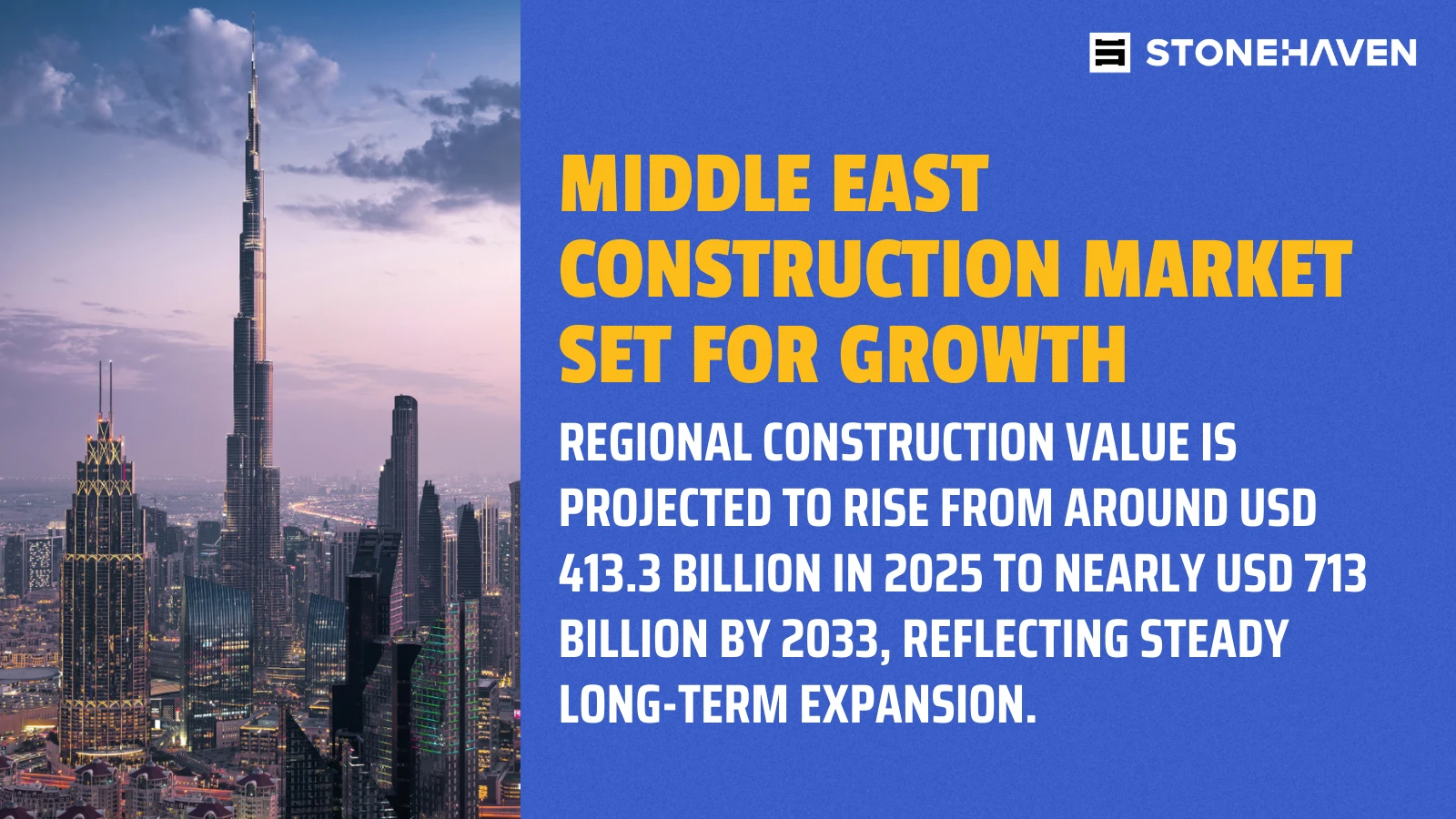
The Middle East construction market continues to grow, although at different projected scales depending on the source. One industry forecast estimates the Middle East construction market will grow from approximately USD 386.1 billion in 2024 to about USD 413.3 billion in 2025, and then to roughly USD 712.8 billion by 2033, representing a CAGR of about 7.05% from 2025 to 2033.
Investment confidence in large capital projects also remains strong. According to the 2025 PwC Capital Projects & Infrastructure Survey, most industry leaders in the Middle East expect increased investment in infrastructure and capital projects over the next two years, reflecting sustained optimism about project pipelines.
At the same time, delivery pressures are increasing due to complexity, regulatory change, material cost volatility and workforce shortages. Factors that can widen the gap between strategic vision and successful execution.
What Is the “Execution Gap” in Mega-Projects?
The “execution gap” refers to the space between strategic project planning and the disciplined implementation required to realise that plan. In the Middle East, where project scales often exceed hundreds of millions or billions of dollars (from integrated urban districts to cross-sector transport and tourism infrastructure) this gap can grow due to:
-
Supply chain instability and logistics challenges:
Global material volatility, shipping disruptions, and regional procurement bottlenecks continue to affect programme certainty, often leading to extended lead times, cost escalation and sequencing constraints across major project packages. -
Complex and evolving regulatory frameworks:
Large-scale developments must navigate multi-authority approvals, changing compliance requirements and jurisdiction-specific planning conditions, all of which can introduce approval delays and redesign risk if not proactively managed. -
Workforce and skills shortages:
Demand for experienced technical, engineering and project leadership talent is rising faster than supply, creating pressure on productivity, quality assurance and the ability to maintain delivery momentum across complex construction environments. -
Technology integration requirements:
The growing reliance on BIM, digital twins, data platforms, and automated reporting introduces coordination, interoperability and capability challenges that must be strategically governed to realise measurable performance benefits.
All of these raise the stakes for timely, cost-effective delivery.
What is the Role of Project Management in Giga Project Execution?
At its core, effective delivery doesn’t start on the construction site, it starts with pre-execution readiness. This includes aligning contractual frameworks, ensuring design maturity at key decision points and integrating risk, cost and schedule considerations early in the life cycle.
Strong project management isn’t just administrative oversight, it’s strategic governance that keeps mega-projects aligned with budget, quality and performance outcomes.
What Digital Tools are Expected for Giga/Mega Projects?
Digital technologies are redefining how projects are planned, coordinated and controlled. Tools like Building Information Modeling (BIM) and digital twins allow teams to visualise, simulate and optimise project outcomes before they are physically built.
-
BIM and digital twins are being widely adopted globally to enhance design coordination, improve collaboration and reduce errors in execution.
-
These technologies transform how data is managed, enabling teams to anticipate clashes, reduce rework and enhance construction accuracy.
While not universally mandated, these tools are increasingly viewed as standard practice on complex projects and are key enablers of measurable performance improvement.
What Role Do Talent, Skills, and Leadership Play in Complex Project Delivery?
Digital tools and strategic planning matter most when paired with strong leadership. Industry reports highlight that workforce transformation and leadership capability are critical to meeting delivery expectations; The construction and engineering sectors are placing greater emphasis on workforce reskilling and digital competence as integral components of delivery performance.
Leaders who can integrate cross-disciplinary teams, drive data-informed decisions and manage risk proactively are in high demand on complex projects where missteps can lead to significant delays and cost overruns.
Risks and Opportunities in Today’s Construction Climate (2026)
The journey from vision to delivery in 2026 is shaped by a more complex global and regional construction environment. Persistent cost volatility, supply-chain uncertainty, regulatory evolution, and rising expectations for digital and sustainable delivery continue to introduce measurable delivery risk. At the same time, organisations that respond with disciplined governance, data-driven planning, and integrated project leadership are finding new opportunities to protect value, accelerate timelines, and enhance long-term asset performance.
Key Risks in 2026
-
Cost volatility and procurement uncertainty:
Material pricing remains sensitive to global energy markets, geopolitical shifts and regional demand cycles, creating budgeting pressure and increasing the likelihood of variation and re-forecasting during delivery.
-
Supply-chain fragility and long-lead dependencies:
Critical components, specialist systems and imported materials continue to carry extended lead times, making programme sequencing and early procurement strategy essential to avoid delay.
-
Regulatory, sustainability, and compliance pressures:
Evolving building codes, ESG reporting expectations and sustainability certification requirements introduce additional approval layers and design obligations that must be managed proactively.
-
Workforce capability and productivity constraints:
Competition for experienced technical and leadership talent is intensifying, with productivity, coordination quality and supervision capability directly influencing delivery outcomes.
-
Digital maturity gaps across project stakeholders:
While BIM, data platforms, and digital twins are advancing, inconsistent adoption across consultants, contractors and suppliers can limit the full performance benefits of digital delivery.
Emerging Opportunities in 2026
-
Stronger cost certainty through early commercial governance:
Front-loaded cost planning, scenario modelling and disciplined procurement strategies are enabling developers to stabilise budgets earlier in the project life cycle. -
Regional growth momentum in the Middle East:
Continued public-sector investment, giga-project programmes, and economic diversification strategies are sustaining one of the world’s most active construction pipelines for organisations able to deliver with certainty. -
Competitive advantage through sustainability and ESG alignment:
Developments that embed low-carbon materials, energy efficiency and regulatory readiness early are better positioned for investor confidence, tenant demand and long-term value resilience. -
Improved asset performance and lifecycle efficiency:
Projects delivered with structured quality assurance, commissioning discipline and data-informed decision-making are achieving stronger operational outcomes and reduced lifecycle cost.
-
Programme acceleration through integrated delivery and digital coordination:
Advanced planning tools, real-time reporting and coordinated design environments are reducing rework, improving sequencing and shortening time to market.
Stonehaven’s Role in Driving Execution Excellence
For firms like Stonehaven, aligning strategy with execution performance isn’t just a service, it’s a disciplined approach that prioritises outcome over optics. Whether supporting contract readiness, delivery governance or digital coordination on complex infrastructure or urban developments, strong project leadership is an essential differentiator.
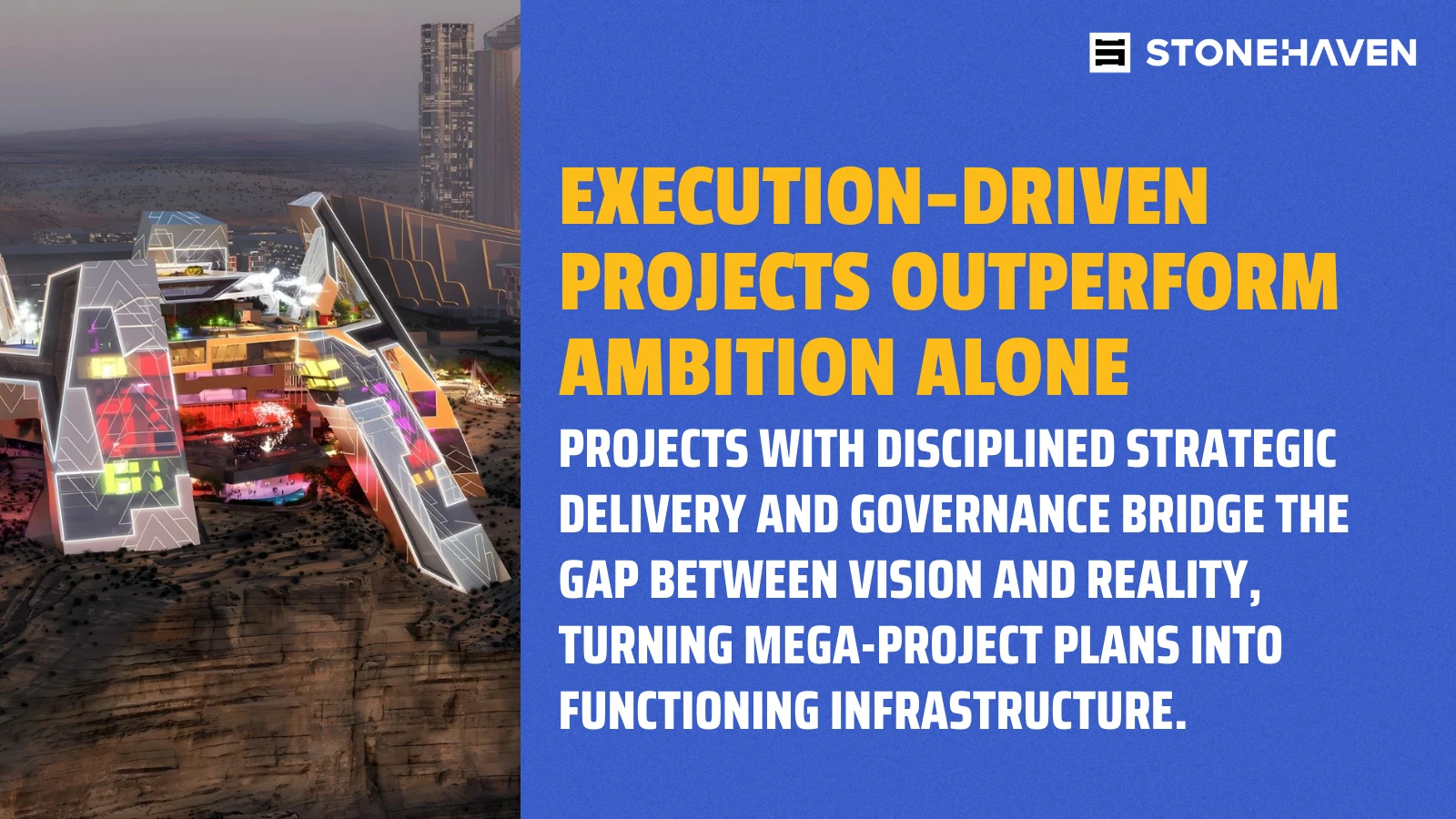
By integrating commercial insight, technical oversight and delivery discipline, Stonehaven helps close the execution gap, enabling regional mega-projects to move from high-resolution renders to functioning realities.
Conclusion: Building the Future with Precision
The Middle East has entered a phase where implementation is as important as ambition. Projects are evaluated not just by their visual appeal or strategic intent, but by their ability to meet performance expectations, generate value, and contribute to sustainable growth.
The execution gap is real and complex. But with disciplined project management, data-driven approaches and integrated delivery models, the vision of today’s mega-projects can become tomorrow’s infrastructure success stories.
About Us
Stonehaven is a trusted project management company and construction consultant based in Dubai, offering comprehensive construction management services across the UAE with offices located in Dubai, UK and Sri Lanka. As one of the leading project management companies in Dubai, we manage projects from inception to completion, ensuring quality, efficiency, and cost-effectiveness at every stage.
We deliver value through expert project management consultancy services, tailored to meet the unique needs of each client. Our core services include Cost Management, Project Management, Construction Supervision, Engineering Support, Design Support, and Marketing & Communications. Whether you’re looking for construction consultants or project managers in the UAE and wider GCC region, Stonehaven is your trusted partner for achieving excellence in your next project.