






28 April 2026
This Week’s Cost Intelligence
Construction costs across the GCC are going up in some areas, but not everywhere. The biggest move this week is nickel, which jumped +7.30%, driven by tighter supply and steady demand from factories. Bitumen also keeps creeping up because it's tied to fuel and energy prices. On the other side, platinum has dipped (–4.02%), with copper and zinc also slipping slightly as global metal markets cool off in spots.
Shipping and logistics costs are still moving up and down rather than settling, mainly because of ongoing tensions in the Middle East and pressure on key shipping routes. Some indices look calmer for now, but fuel prices and insurance costs are still pushing up the final cost of materials when they land here.
Overall, the market is mostly stable but reactive. The buying risk is sitting in nickel-heavy packages and a few commodity-linked materials, but not across the whole supply chain.
STONEHAVEN COST INDEX HEADLINE KPIS
SCI Issue 15 · 21–28 Apr 2026
Cost Index 0.00 As of 28 Apr 2026
Index 0.00 Sub-index reading
Source: Stonehaven Cost Index Issue 15 · 21–28 Apr 2026
SCI VS BASELINE — 28-WEEK TREND
Stonehaven Cost Index, weekly. Baseline 01 Sep 2025 = 100.
Source: Stonehaven Cost Index Issue 15 · 21–28 Apr 2026
SCI WEEK-ON-WEEK % CHANGE
Weekly movement of the Stonehaven Cost Index — momentum over the last 27 readings.
Source: Stonehaven Cost Index Issue 15 · 21–28 Apr 2026
Driver Note

Material Movement This Week
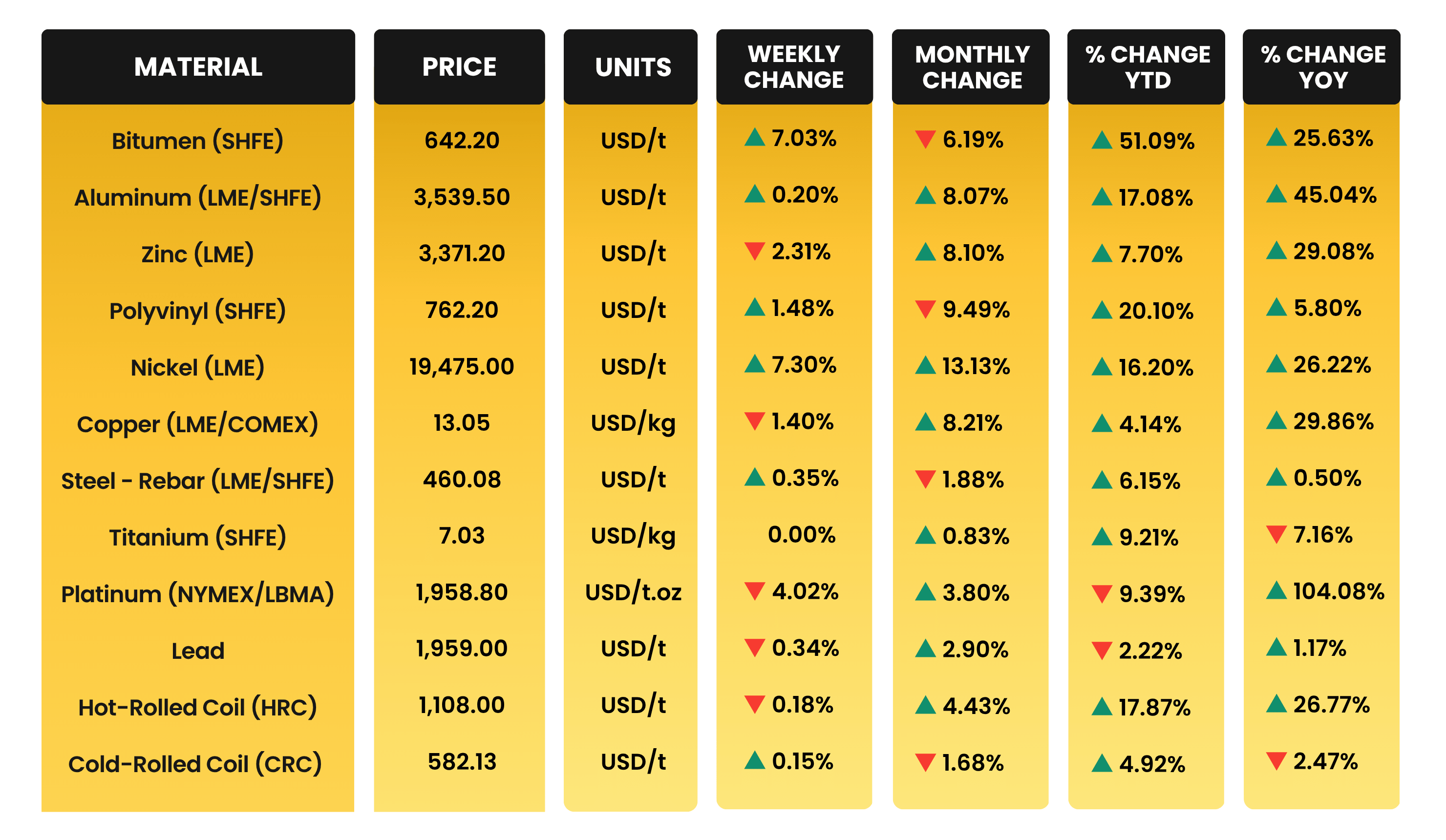
Data as of 28th April 2025 - 28th April 2026
To view the price fluctuations in detail, please download our latest dataset below.
CUMULATIVE % CHANGE VS BASELINE BY MATERIAL
How far each tracked input has moved since 01 Sep 2025 = 100.
Source: Stonehaven Cost Index Issue 15 · 21–28 Apr 2026
Market Material Watchlist
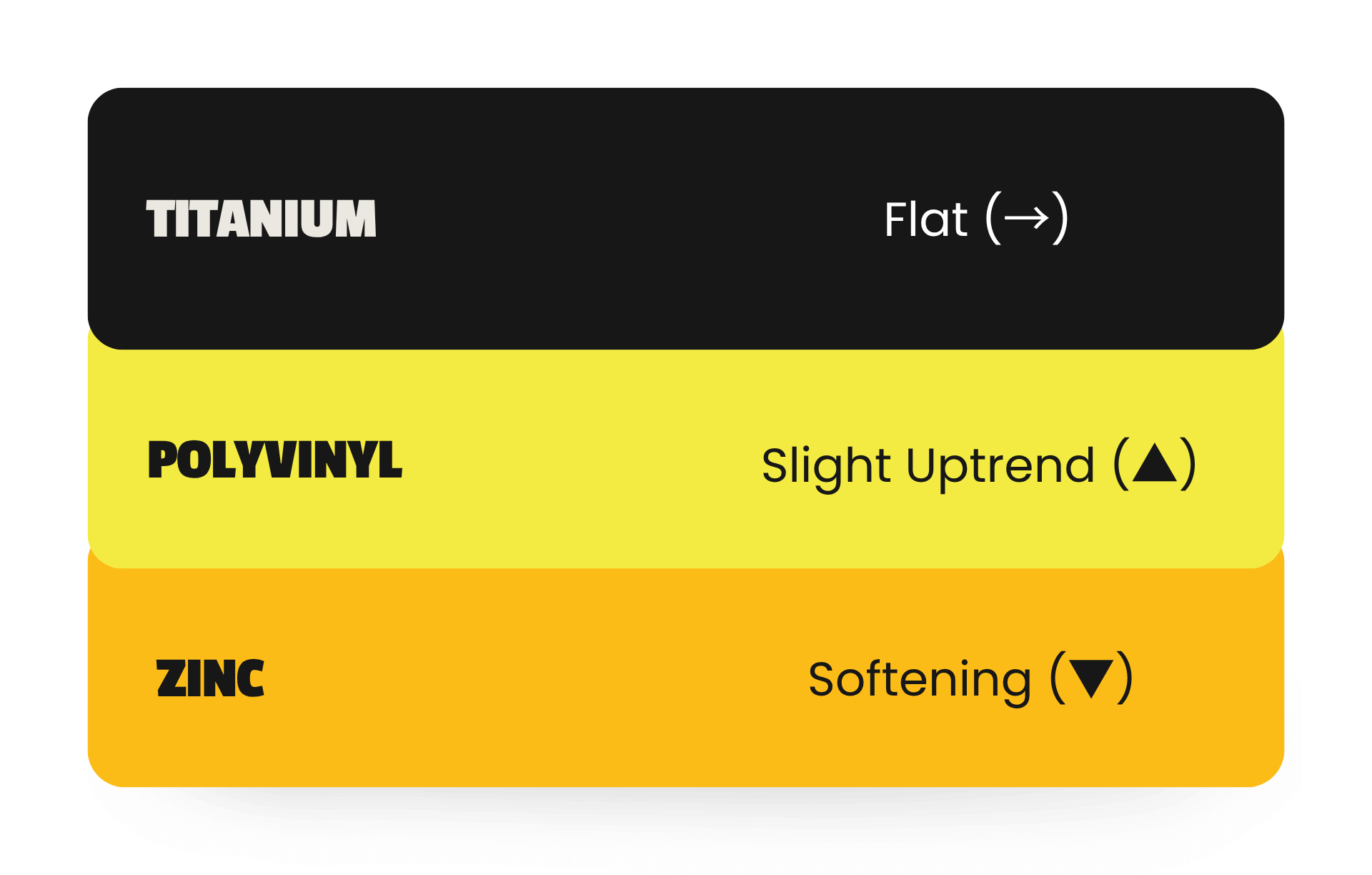
Titanium – Flat (→) Forecast:
Prices are expected to remain relatively stable with minor fluctuations, supported by balanced specialised industrial demand and steady supply conditions.
Watchlst: Construction demand, availability of titanium for structural components, supply chain constraints, and fluctuations in processing costs.
Polyvinyl – Slight Uptrend (▲) Forecast:
Prices are expected to increase modestly, supported by gradual rises in petrochemical feedstock costs and stable polymer demand.
Watchlist: Oil price movements, polymer demand trends, feedstock availability, and regional supply chain conditions.
Zinc – Softening (▼) Forecast:
Prices are expected to soften slightly in the near term, influenced by easing industrial demand, improving supply conditions, and fluctuations in global metal inventories.
Watchlist: Global construction and manufacturing demand, LME inventory levels, mining output, energy costs, and macroeconomic conditions affecting base metals demand.
THIS WEEK'S MARKET MOVERS — WOW %
Material-by-material price movement over the week ending 28 Apr 2026.
Source: Stonehaven Cost Index Issue 15 · 21–28 Apr 2026
SCI SUB-INDEX TRENDS
Click a tab to view that index — Materials, Labour or Plant.
Source: Stonehaven Cost Index Issue 15 · 21–28 Apr 2026
Material Movement & Cost Implications
This week's material trends show a clear split between metals where supply is tightening and metals where prices are softening:
-
Upward Pressure:
- Nickel (+7.30%) – tighter supply, steady factory demand
- Bitumen – still climbing because it's tied to fuel costs
-
Stabilising / Neutral:
- Steel-rebar, HRC, CRC – moving very little, under 0.5% either way
- Aluminium – stable, alongside titanium and lead
-
Downward Correction:
-
Platinum (–4.02%), copper, zinc – factories slowing down and global metal prices dipping
-
Our Commercial Interpretation
Prices aren't rising across the board. The pressure is sitting in nickel-heavy packages and a few commodity-linked materials. That means smart, targeted buying and not a full inflation adjustment to your budget.
Involvement of Cement in the Construction Industry
From a buying and budgeting point of view, cement is still one of the biggest cost drivers on any concrete-related package. When cement prices move, it directly hits budgets, tender prices and cost plans. So, choosing the right type, where you buy it from, and how it's priced really matters both for performance and cost control.
1. Ordinary Portland Cement (OPC) – Typically used for general construction works
2. Portland Pozzolana Cement (PPC) – Offers enhanced durability and improved long-term performance
3. Rapid Hardening Cement – Specified where early strength gain is critical to programme requirements
4. Sulphate Resistant Cement – Utilised in aggressive ground or marine environments to mitigate sulphate attack and ensure structural longevity
Impact of Market-Driven Price Volatility on the Middle East Construction Industry
Global market disruptions are causing price swings that are shaping both today's market and what comes next by looking purely at the economy and supply chain. Right now, jumpy energy prices are pushing up the cost of making and moving materials, and that's hitting key items like cement, steel rebar, aluminium and other energy-heavy products.
At the same time, shipping problems are causing higher freight costs, longer delivery times, and more uncertainty when buying. Contractors can't predict costs as easily at tender stage, so they're adding risk buffers, keeping bids valid for shorter periods, and using more provisional sums.
Looking ahead, this is pushing the industry towards a more planned, strategic way of buying by buying earlier, using more suppliers, and locking in prices where possible. From a commercial point of view, the industry is becoming more risk-aware, and cost planning, contracts and procurement strategies all have to adapt to keep projects viable.
Currency & Inflation Lens
AED vs Key Trading Currencies
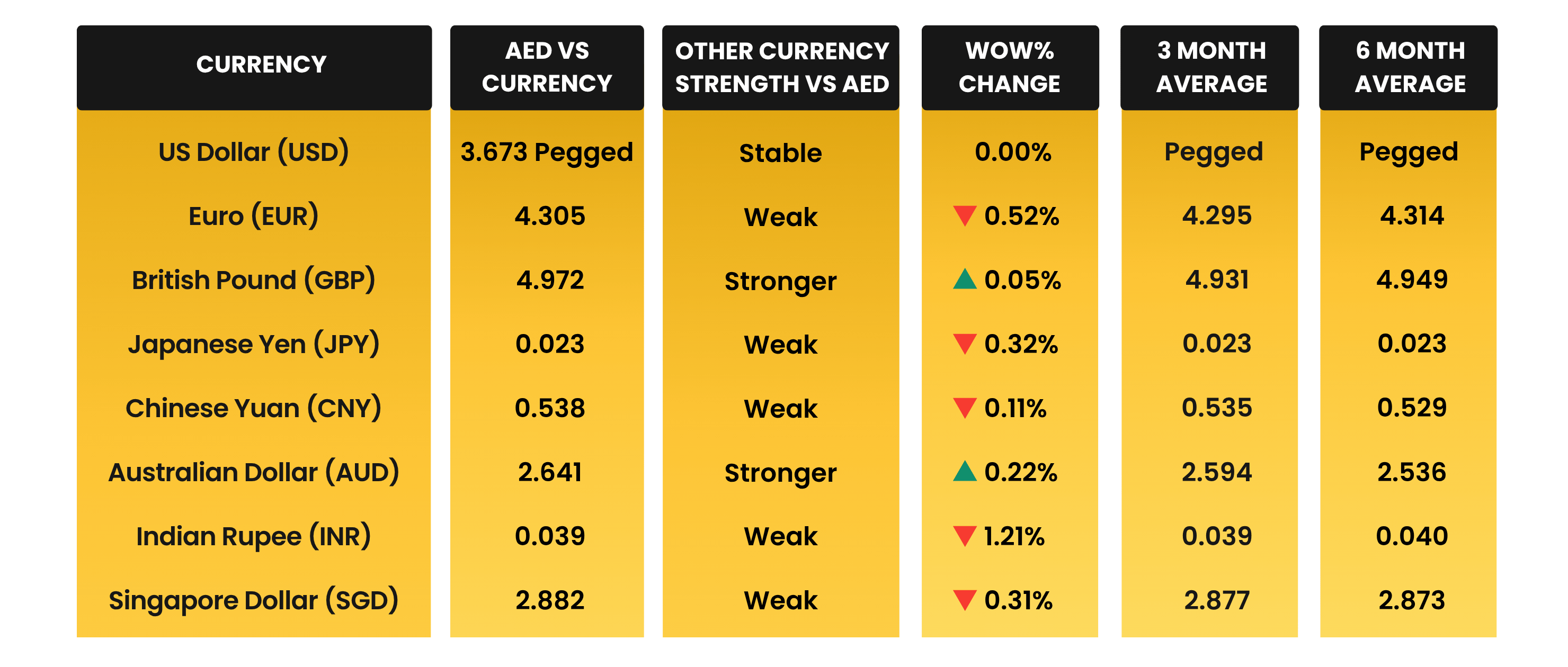
AED FX EXPOSURE — WOW % CHANGE
Weekly currency moves against AED across the eight tracked import-pricing pairs.
Source: Stonehaven Cost Index Issue 15 · 21–28 Apr 2026
SAR vs Key Trading Currencies
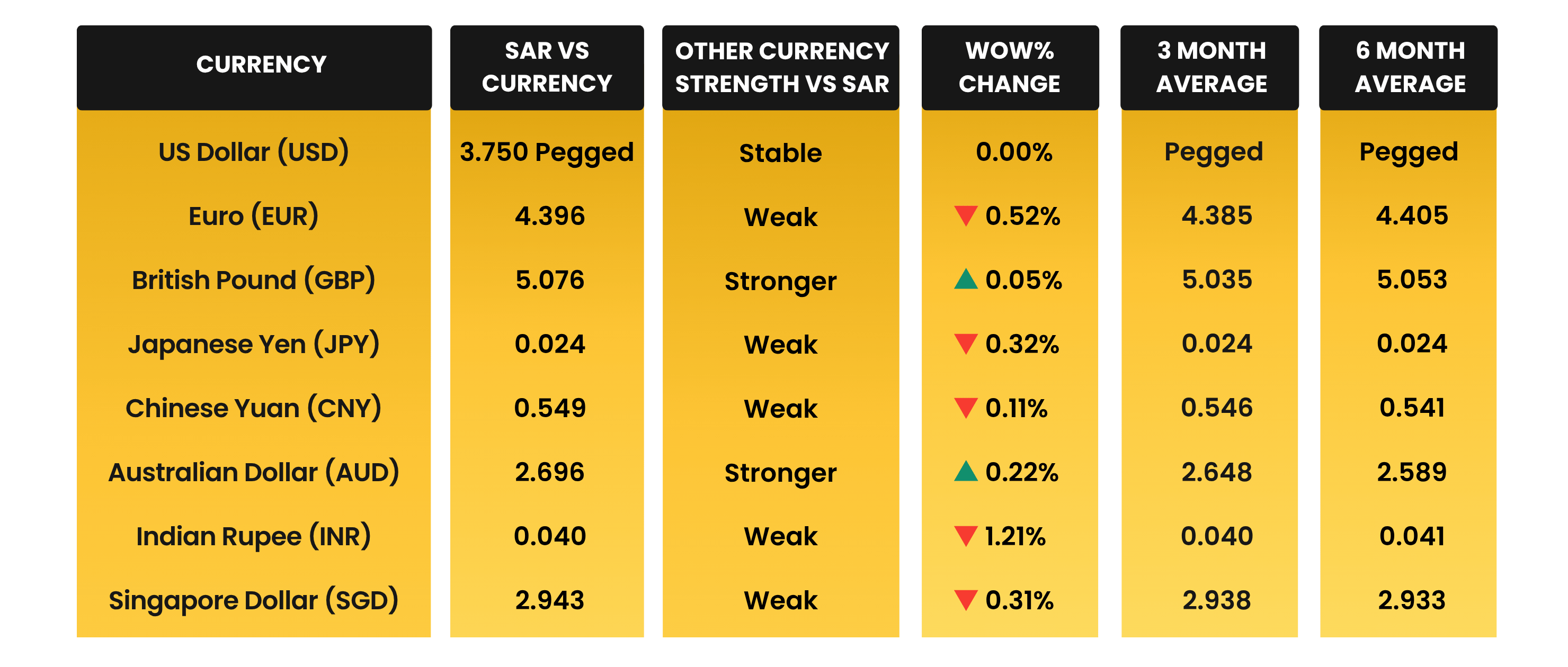
SAR FX EXPOSURE — WOW % CHANGE
Weekly currency moves against SAR across the eight tracked import-pricing pairs.
Source: Stonehaven Cost Index Issue 15 · 21–28 Apr 2026
Stonehaven Analysis
Most major currencies (EUR, JPY, CNY, SGD, INR) have weakened against both AED and SAR this week. That's mostly because GCC currencies are pegged to a strong US dollar.
The Indian Rupee took the biggest hit at –1.21%, while the Australian Dollar and British Pound nudged slightly stronger.
Overall, this makes it cheaper to import materials right now, especially from Europe and Asia.
Impact on Construction Costs
1. Imported Materials
A stronger AED and SAR mean you get more for your money when buying from abroad, especially Europe and Asia.
What this means:
-
Slightly lower landed costs on imported materials
-
Helps contractors offer better prices on steel, finishes and MEP packages
-
But this saving comes from currency moves only — it's not a real long-term price drop
2. Currency Risk
Currency moves are working in our favour right now, but they're driven by outside factors like a strong US dollar and the wider economy so they can flip quickly.
What this means:
-
No need to change your cost plans right now
-
Keep watching, especially on long-lead procurement packages
-
Don't add inflation buffers just because of short-term currency moves
Overall Market Position
Currency moves are helping cancel out some of the inflation pressure from energy and shipping. But the benefit is small, not game-changing.
In short:
-
Materials: Slight cost advantage from imports
-
Overall: Stable, with a small cost break and not a full price correction
Global Inputs & Freight Benchmarks
Logistics & Freight – Construction Cost Multipliers
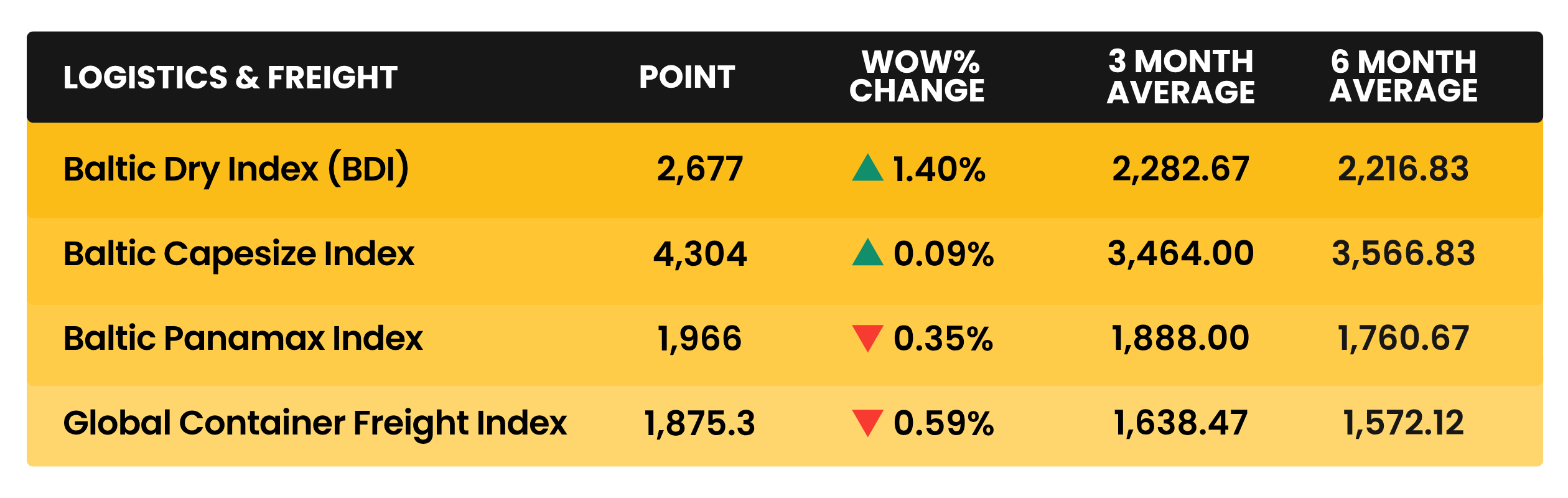
*Data as of 28th April 2026
FREIGHT & SHIPPING INDICES
Click a tab to view that index — Baltic Dry, Capesize, Panamax or Container. Monthly readings.
Source: Stonehaven Cost Index Issue 15 · 21–28 Apr 2026
Stonehaven Procurement Strategy Index (SPSI)
The SPSI provides a simple view of current procurement risk in the construction market, based on three key factors:
-
Market Volatility (MVEI) – how much material prices are moving
-
Import & Currency Exposure (ICEI) – how much currency changes affect what you import
-
Energy & Logistics (ELEI) – how much fuel and freight costs are pushing things up
Each one scores 1 to 4, where 1 means stable and 4 means high risk. The overall SPSI uses the same scale:
-
Below 1.5: Low risk – market stable, very little price movement
-
1.5 to 2.25: Mild risk – small price moves, keep an eye on it
-
2.25 to 3.25: Moderate risk – clear market movement, take targeted action
-
Above 3.25: High risk – the market is shaky, review your buying right away
Current Position (28 April): SPSI = 1.45 (Low Risk)
-
MVEI = 2 → prices for key materials are moving a bit, but nothing dramatic
-
ICEI = 1 → very little currency risk — exchange rates aren't really affecting import costs, and currencies are stable
-
ELEI = 1 → very low energy and shipping risk — fuel prices are steady, freight isn't bouncing around, and supply chains are calm
Interpretation:
The market has settled this week. Currency and shipping pressures have eased a lot, and buying conditions are good right now. You can carry on as normal.
Procurement Recommendation
1. Material Procurement: Carry on as normal since the market is stable, just keep routine checks going. Prices aren't moving enough to change how or when you buy.
2. Currency & Import Strategy: Keep buying imports the usual way. Just track current exchange rates so there's no need to lock in rates or hedge unless things change.
3. Energy and Logistics Cost Management: Energy and logistics conditions are stable, allowing procurement and delivery scheduling to continue as planned without early purchasing or cost-hedging requirements.
4. Continuous Monitoring: Stay on top of market signals so you spot any change early. Conditions are calm right now, but that can shift quickly.
MATERIALS BASKET COMPOSITION
Hover any wedge for material name and basket share.
Source: Stonehaven Cost Index Issue 15 · 21–28 Apr 2026
STEEL COMPLEX PRICE TREND
Click a tab to view that input — Rebar, HRC or CRC. Prices in USD per tonne, weekly.
Source: Stonehaven Cost Index Issue 15 · 21–28 Apr 2026
Recommendations for Material Purchasing
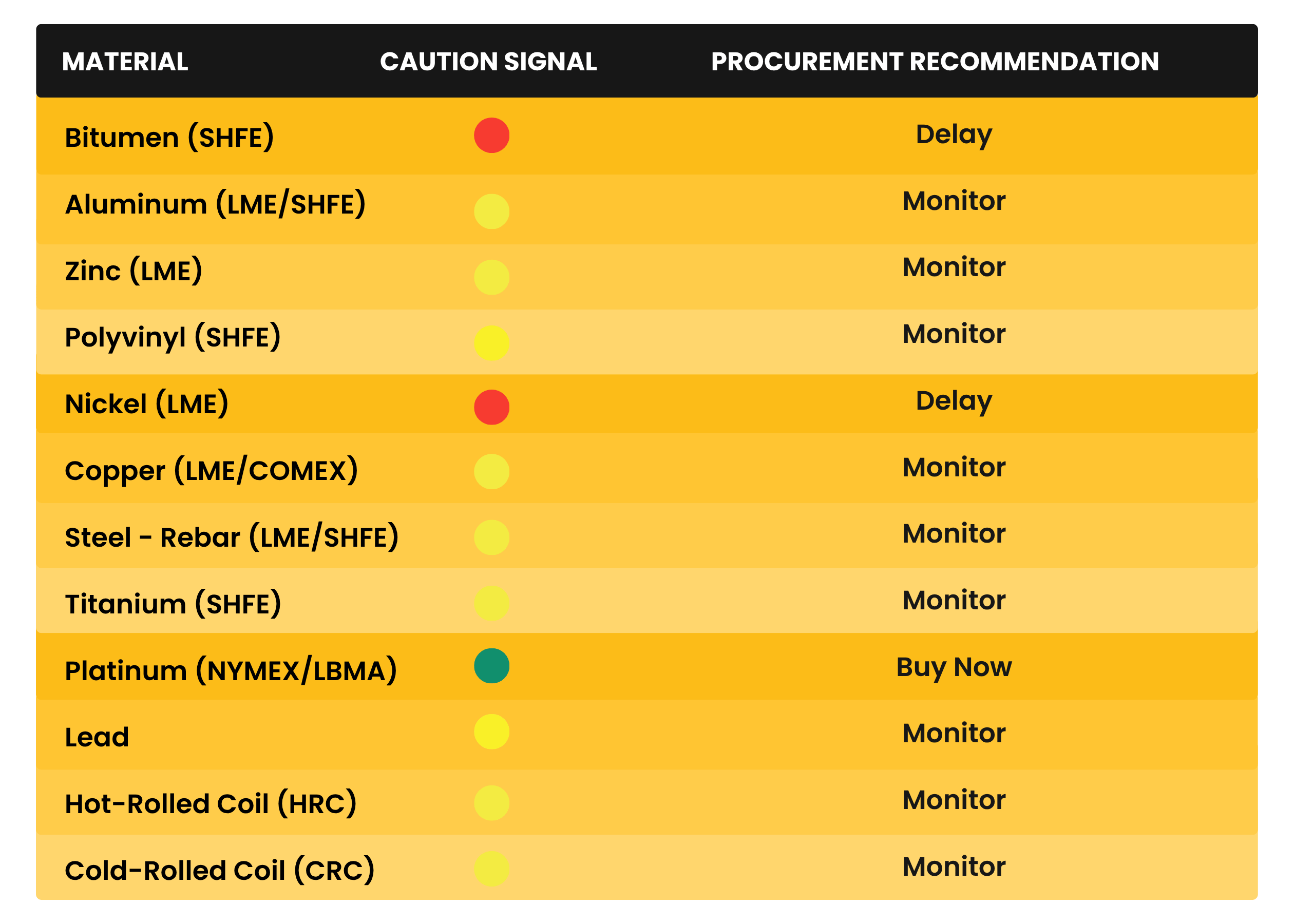
Commercial Guidance
1. Structural & Steel Packages
Zinc, aluminium, titanium and lead are all trending up, so some price pressure is showing up in galvanised steel, cladding and specialist metal work.
But the main structural materials like rebar and CRC are either holding steady or dipping slightly. So, the main structural packages are still well-balanced on cost.
The cost risk sits with non-ferrous metals and finishing materials, not the primary steel structure.
2. Industrial, Commercial & Infrastructure Projects
Demand across infrastructure and industrial sectors is steady, which is supporting non-ferrous metals. Stable HRC and polymer prices are also helping keep overall costs balanced.
But high diesel prices and rising bulk freight rates are pushing up shipping costs, especially on bulk and imported materials.
Add cost buffers only to packages that rely heavily on shipping or metal, not across all trades.
3. MEP, Finishes & Specialist Imports
Copper, nickel, platinum and CRC are stable or easing slightly, which is keeping prices steady across MEP systems, cables and imported equipment.
Normal competitive tendering and buying cycles still work fine, and there's room to grab good prices on packages where prices have dipped short-term.
Procurement Strategy
We recommend a targeted approach, with timing in mind. Buy early on materials that are trending up (zinc, aluminium, lead), and take advantage of good prices on copper, platinum and CRC.
Most other materials should just be monitored where the trends are mixed, and shipping and energy are still moving around.
Overall Commercial Position
Construction cost risk remains controlled and execution-driven, with upward pressure primarily linked to logistics, fuel costs, and select non-ferrous metals.
Despite a notable increase in the SCI driven by diesel and freight, the broader material market continues to reflect a balanced cost environment outside energy-linked inputs, supporting a measured and strategy-led procurement approach.
Important Disclaimer
The Stonehaven Cost Index (SCI) is for general information only and is not a commitment, guarantee, or offer to contract at any price. The index is based on publicly available commodity data and our internal market view as of 28 April 2026. Actual project costs depend on the specific scope, how you procure, and what's agreed commercially.
Stonehaven Project Management Services LLC accepts no liability for any loss caused by relying on this document without proper project-specific advice. The index shows general market movement based on weighted construction inputs.
FAQ's
1. What is the Stonehaven Construction Cost Index and how is it calculated?
The Stonehaven Cost Index (SCI) tracks weekly price movements across key construction materials, freight indices, and currency pairs relevant to the UAE and Saudi Arabia. Data is collected every week and reviewed by Stonehaven's cost management team before publication. The index is indicative and does not constitute a tender price or contractual valuation.
2. What affects construction material prices in the Middle East?
Several factors influence construction material prices in the Middle East, including global commodity markets, shipping costs, fuel prices and currency movements. Materials like steel, copper and bitumen are particularly sensitive to international demand and logistics conditions, which directly impact construction cost trends in the GCC.
3. How often do construction material prices change?
Construction material prices can change daily depending on global market conditions. Factors such as commodity prices, shipping costs and fuel rates influence short-term movements, which is why tracking weekly construction material price updates is important for sensitive cost planning.
4. How is the Stonehaven Construction Cost Index prepared?
The construction cost index is prepared using weekly data collection across key materials, currencies and freight rates. Cost managers monitor these movements to reflect current conditions. This is then reviewed by the commercial management alongside foreign exchange and logistics trends, which influence construction pricing across the GCC before presenting to our readers.
Check Out Our Previous Issues

Talk To Our Team
Speak to our cost management specialists to benchmark, forecast, and protect your project margins, using real data from the Stonehaven Cost Index.